Anthropic would like you to believe that you don’t need to deal with code anymore. Just prompt your agent, set up the right guardrails, port everything to Rust, and you’re on the path to success. All of the major LLM companies heavily or exclusively use LLMs to develop their consumer software. And of course they do. How bad would it look if Anthropic told you to use Claude for all of your programming tasks - but they don’t really trust it to develop their products.
Tag: Programming

A year ago I watched this video about how double pendulums aren’t always chaotic.
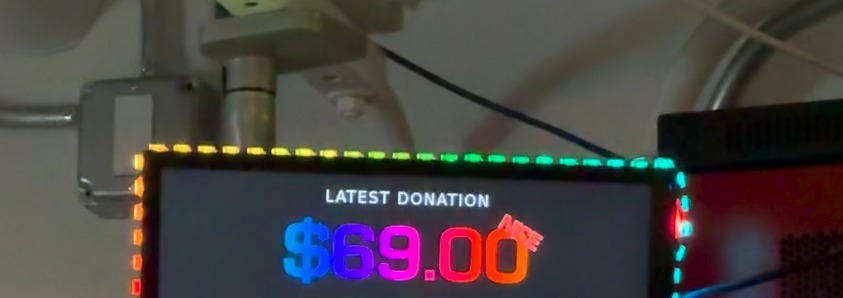
I gamified donations in an organization that gives everything away for free.
I volunteer at Noisebridge, a hackerspace in San Francisco. Anyone can walk in off the street and use our 3D printers, sewing machines and electronics lab. No dues are required. Newcomers sometimes ask how to become a member. I’ll tell them “You already are!” but what they’re really asking is how to formalize the relationship: give money, get access. They already have access. So the trick is getting people to pay for something they get for free.
The programmer internet is polarizing over ChatGPT. Some claim that it is nearly AGI, some claim it cannot do anything of value, with plenty of people in between. I’ve worked with GPT-3 professionally, used CoPilot for over a year, and recently started programming side-projects with the assistance of ChatGPT (I pay for GPT-4 access). I’m considering working with LLMs full time again, so I pay close attention to what the GPT models can actually do.
One year ago I looked around for existing tech that would provide me with compile-time guarantees for a REST-ish API interface. With full-stack TypeScript web applications reaching a level of maturity where I, a previously die-hard Rails developer, felt comfortable taking the dive - it seemed like the Node ecosystem was lacking in ties between the front end and back end.
What is BrainFuck? BrainFuck is an esoteric programming language designed specifically to be easy to compile. The environment provides the programmer with an “infinite” array of bytes (traditionally just 30,000) and a data pointer. There are only 8 single character commands:
A common riddle-like question for programmers asks them to swap the values of two integers without a temporary intermediate value. There are two common solutions that I’m aware of, addition swap and XOR swap. Here’s what each looks like in C:
Shaders provide programmers with a beautiful combination of art and math. Most other throwaway projects are devoid of any artistic value. In less than a dozen lines of code you can draw fractals. A few more and you can start creating intricate animations. The most interesting part is the unique perspective they force you into.
Say you want to draw a circle in an imperative programming language. You need to break out a for loop and calculate the sin and cos of different angles until you have points all around the circumference of a circle.
The intention is to force myself to get a small taste of a bunch of new programming languages and programming paradigms. Since I was late to the party I rushed through the first 4 problems in languages I’m familiar with. But for day 5 I solved the daily problem with MIPS assembly. I look forward to learning and writing Common Lisp, Haskell, Prolog, and many more languages.
One hope I have is to complete a problem in GLSL. I’m already somewhat familiar with GLSL, but given its intended purpose it should be a true feat if it works.
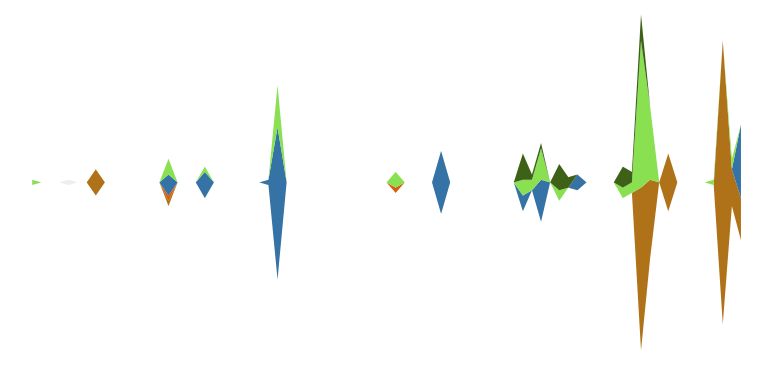
After a stroke of inspiration earlier this evening I hacked together this tool. It produces a stacked time-series graph of GitHub commit data. The commit data is organized by language and uses the same colors as GitHub for each corresponding language.